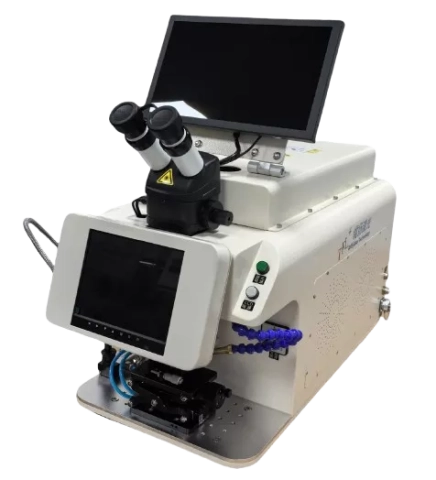
Laser Microwelding (Generic-Benchtop)
Price
€ 0,00
The Desktop Generic Laser Microwelding Unit is a compact system for precise microjoining, ideal for prototypes, R&D, training, and delicate repairs.

Manufacturer:
Toflylaser
SKU:
MU010101A
The Desktop Laser Microwelding Unit is a bench‑scale laser joining platform designed to bridge the gap between laboratory development and low‑volume production. It combines a stabilized fiber‑laser source, precision beam delivery optics, vision‑assisted alignment, and programmable process recipes to enable repeatable, low‑heat welds on thin metals, plated components, and miniature assemblies.
Key capabilities
- High precision microjoining with tightly focused spot sizes and controllable pulse regimes for minimal heat‑affected zones.
- Repeatable process control through programmable profiles, closed‑loop power monitoring, and automated sequencing for consistent first‑pass yields.
- Vision‑assisted alignment and configurable fixturing to support sub‑100 µm placement accuracy and fast changeovers between part variants.
- Compact sealed work envelope with safety interlocks and fume extraction readiness for bench and cleanroom environments.
- User‑centric interface that supports training workflows, recipe management, and exportable process logs for traceability.
Typical applications
- Prototype production and design iteration for medical implants, microfluidic parts, and miniature housings.
- Research and development where bench‑scale validation of laser joining parameters is required before scale‑up.
- Hands‑on training of production personnel to transfer process knowledge and establish operator competency.
- Precision repair and refurbishment of surgical tools, stents, guidewires, and electronic assemblies that require localized, low‑distortion joins.
Performance considerations
- Materials: optimized for stainless steels, nitinol, CoCr alloys, and plated surfaces; parameter windows must be established per alloy and plating condition.
- Process windows: pulse energy, pulse duration, repetition rate, focal position, and shielding atmosphere strongly influence weld morphology and fatigue performance.
- Fixturing: rigid micro‑fixturing and active alignment reduce movement and improve yield for multi‑strand or braided geometries.
- Validation: mechanical tests (tensile, fatigue), metallography, and micrograph inspection are recommended for medical applications and regulated products.
Integration and serviceability
- Footprint and utilities suited for bench installations; minimal site preparation compared with floor systems.
- Modular optics and user‑replaceable consumables simplify maintenance and reduce downtime.
- Data logging and exportable process reports support quality systems and regulatory documentation.
Commercial and logistical note
Units are stocked in China and supplied on a per‑order basis; lead times and shipping options will be confirmed at the time of purchase. International customers should account for customs, import compliance, and local service support when planning deployment.
Value proposition
For teams needing industrial‑grade welding fidelity at bench scale, this Desktop Laser Microwelding Unit shortens prototype cycles, reduces repair turnaround, and enables repeatable training and validation workflows—delivering a compact, serviceable platform that preserves material properties while providing production‑relevant process control.
- Product Type: Desktop Laser Microwelding Unit
- Use Cases: Prototype production; R&D; operator training; precision repair of biomedical and microelectronic components
- Laser Source: Stabilized fiber laser (pulsed modes) with programmable pulse profiles
- Peak Control: Closed‑loop power and pulse control for repeatable welds
- Spot Size: Micron‑scale focusing optics for sub‑micron positional control
- Alignment: Vision‑assisted alignment with configurable fiducial/marker recognition
- Fixturing: Configurable micro‑fixturing and modular clamps for small assemblies and guidewires
- Work Envelope: Sealed bench‑top enclosure with safety interlocks and viewing port
- Automation: Programmable recipes and automated sequencing for batch workflows
- Monitoring & Logging: Real‑time process monitoring and exportable process logs for traceability
- Atmosphere Options: Inert gas purging compatibility (argon/nitrogen) for oxidation‑sensitive alloys
- Material Compatibility: 316L/316LVM, Nitinol, CoCr, MP35N, plated alloys and common biomedical metals
- Serviceability: Modular optics and user‑replaceable consumables for rapid maintenance
- Safety & Compliance: Integrated interlocks, fume extraction readiness, and cleanroom‑friendly design
- Footprint & Power: Bench‑scale footprint, standard mains power, minimal site prep (specs provided on request)
- Documentation: Includes operator manual, training materials, and exportable weld/process reports
- Stock & Delivery: Units stocked in China; shipped per order (lead time confirmed at purchase)
Powered by Phoca Cart


Laser Microwelding (Generic-Benchtop)
The Desktop Generic Laser Microwelding Unit is a compact system for precise microjoining, ideal for prototypes, R&D, training, and delicate repairs.

Laser Cutting
A fiber laser cutting machine operating at a 1064 nm wavelength delivers exceptional beam quality and very high power density, enabling efficient absorption and clean cutting of metal precision components. With a focused spot and fast vaporization, it achieves kerf widths of 0.05–0.20 mm and positioning accuracy of 0.05 mm with 0.03 mm repeatability.

Laser Microwelding (Generic-Industrial)
The Industrial General Laser Micro Welding Unit, designed for precision microjoining, is an excellent, compact, and versatile system for prototypes, R&D, training, and precision repairs.

Laser Microwelding (Catheter-Benchtop)
Laser welding machines designed for various catheter types and sheath tubes. Capable of handling wire diameters as small as 25 μm.


Three-glove Glovebox
The three-glove glovebox provides a spacious and versatile environment for sensitive experiments requiring multi-user access. With premium components and advanced control systems, it ensures maximum reliability in research and production workflows.

Laser Microwelding (Catheter-Industrial)
Industrial laser welding systems engineered for catheter and stealth wire tube production, capable of handling diameters as fine as 25 μm. Built for continuous operation, they ensure precise, reliable joints across diverse medical components.

Laser Welding (precision-3C-benchtop)
A fiber‑delivered energy‑feedback laser welding system enables stable, high‑energy welding of full‑aluminum frames used in ultra‑thin phones, overcoming CNC processing limits for midplates. The system produces repeatable welds with low thermal distortion suitable for R&D and small‑batch production.


Laser Welding (precision-3C-industrial)
 An industrial fiber‑delivered, energy‑feedback laser welding system provides high‑power, stable welding for full‑aluminum frames in ultra‑thin device production. Integrated robotic handling, closed‑loop monitoring, and inline inspection enable repeatable weld quality, high first‑pass yield, and seamless MES/ERP integration.

Newstandart Glovebox
The new standard glovebox provides a secure and controlled environment for sensitive experiments and material handling. Built with durable stainless steel and premium components, it ensures long-lasting performance.

Single GloveBox
The single-station glovebox provides a secure and flexible environment for sensitive experiments and material handling. Built with world-renowned components, it ensures durability, reliability, and long-term performance.


 WhatsApp
